In New Guinea in the 1930s, Western anthropologists were intrigued (and amused) to see the men of a remote tribe wearing empty Kellog’s Corn Flakes boxes as hats. The colourful image of Cornelius Rooster on the packet appealed to the tribesmen and the boxes were considered the apogee of fashionable headgear. I tried one on myself the other day – it was comfortable, warm and certainly turned a few heads on College Street. Someone even complimented me on my conscientious recycling abilities. The same tribe in New Guinea also used old tin cans as belt ornaments, again in the name of fashion, but I haven’t yet copied that idea.
Is it such a long stride between using food containers as clothing and using actual food? Until quite recently, the best-known examples of the latter were Carmen Miranda’s tutti-frutti turbans from the 1940s and ’50s, towering assemblages of fruit as bright and as merry as the great entertainer’s smile. It took Montreal artist Jana Sterbak to introduce an element of seriousness to the notion with her famous dress made of raw steak, first displayed on a coat hanger at the National Gallery of Canada in 1987. The title of the piece, Vanitas: Flesh Dress for an Albino Anorectic, hinted at all sorts of complicated semiotics around the impermanence of food, of fashion and of life itself. Some people found it revolting, others inspiring; many were disturbed by the implicit reminder that humans themselves are essentially meat with a limited shelf-life.

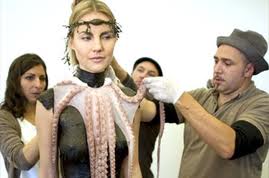
The idea of food couture returned recently when Lady Gaga actually wore a dress made of steak at the 2010 MTV Video Music Awards. Animal rights activists were furious but Time magazine declared it the year’s top fashion statement. Undoubtedly, the purpose of the stunt was to shock but the dress was rather beautifully cut (or should that be carved?) and looked, from a distance, like heavy silk. It reminded me of the striking images created by photographer Helge Kirchberger and chef Roland Trettl in which glamorous fashion models are dressed in various foods – an evening gown of cabbage leaves, a shawl of cawl fat, a chocolate bustière, a headdress made from a very large raw octopus, its tentacles draped elegantly around the model’s face, neck and shoulders while she stares with humourless inscrutability into the camera’s lens.
There will always be a measure of surreality to clothing made from food. Salvador Dali and his colleagues were hugely influenced by the works of Giuseppe Arcimboldo (1527 – 1593), the Italian artist who painted portraits in which not only clothes but also his subjects’ faces and bodies were made of overlapping plants and vegetables, fish and fruit, arranged to give a trompe d’oeuil likeness of humanity. Contemporary reaction ranged from mirth to outrage, but the philosophical message was real enough. You are what you eat. You are what you wear. You wear what you eat… Suddenly the notion of a hat fashioned from a Corn Flakes box doesn’t really seem wacky at all.