
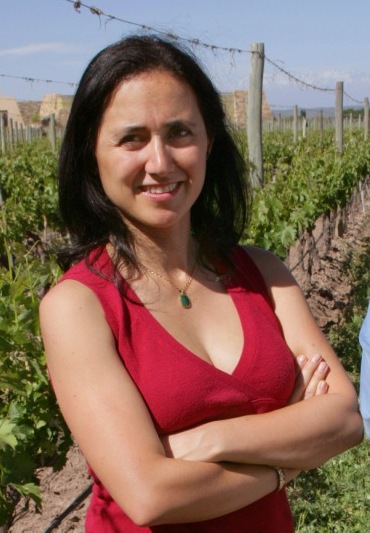
Yesterday I had the pleasure of meeting a most impressive woman – Laura Catena. In her native Mendoza, Argentina, she is the vice president of Bodega Catena Zapata, one of the most innovative and iconic wineries in the country. With her father, Nicolas, she is responsible for wines under the Catena, Catena Alta, Catena Zapata, Tilia and Alamos labels. She is also the owner and founder of Luca wines and creator of La Posta winery, which showcases wines made from the grapes of prodigiously gifted smallholders and farmers. Oh yes and she’s also a full-time emergency room doctor in San Francisco where she lives with her husband and three children. In her spare time she has written a book, just published, that is the most thorough, savvy and interesting introduction to the Argentinean wine industry I have ever read. It’s called Vino Argentino and is published by Chronicle Books. I found my copy at the Cookbook Store. Yesterday, she was in town for a day of public relations events then off to New York for more of the same. So I was lucky to be one of the two wine writers (David Lawrason the other) that her Toronto agent, Alex Gaunt of Trialto, invited to his Liberty Village office for a tasting.
After whetting our palates with a little crisp, aromatic Tilia Torrontes (the only Torrontes at the LCBO these days and a fine example of that perfumed grape) we began with the Luca Chardonnay 2008. We don’t see much high-end Argentinean Chardonnay in Ontario though it’s the grape that first lured the world to take an interest in Argentinean wine, back in the 1990s. This one is grown at 5000 feet in Tupungato, in the foothills of the Andes where the sunlight is fiercely bright but the temperatures pretty much Burgundian. It’s gorgeous – full-bodied, ripe, full of intense aromas and flavours of tropical and citrus fruit but with a fresh, minerally finale. It sells for less than $30 and is worth every cent.
We also tasted La Posta Bonarda 2008 an elegant floral red. After Malbec, Bonarda is the most planted red variety in Argentina. With their strong Italian heritage, most Argentineans assume it is the same grape as the northern Italian Bonarda – “They have willed it to be Italian,” says Laura Catena. As she points out in her book however, it’s actually a French grape – the Charbonneau from Savoie. Look how well it has done in Argentina!
Ditto Malbec, of course. But here we should correct an often-heard mistake. Malbec is rare in France these days – confined to the inky wines of Cahors and almost extinct in its native Bordeaux, though it is still listed as an allowed component of the Bordeaux blend. People assume it must always have played a minor role in Bordeaux but in fact it was an equal player with Cabernet Sauvignon until the phylloxera blight in the last quarter of the 19th century, when Europe’s vineyards were all but wiped out. The solution, as we all know, was to replant with American rootstock, immune to phylloxera, but Malbec did not take kindly to the process. Merlot did – which is why Merlot is now Cabernet’s companion in Bordeaux instead of noble Malbec.

Fortunately for the world, Malbec had already been taken to Argentina and was doing well. We can taste how well today in the wines Laura Catena poured for us yesterday. Catena Malbec is available at Vintages for around $20. If I had to pick one Argentinean Malbec as the archetype of the style it would be this one. Laura puts it more poetically: “This is the Chanel jacket of Argentinean wine,” classic, elegant and always appropriate. It’s a blend of fruit from five of the estate’s vineyards, including some very high altitude plantings for heady aromatics and some in the lower-lying Maipu region for richness and warmth. “I despise flabbiness in wines,” says Laura – hence the bright acidity that underpins all the rich black fruit and makes this such a successful food wine.
Then there is Catena Zapata Malbec Argentino. We tasted the 2005 yesterday. It sells at around $90. There’s a much bigger qualitative gap between a $10 wine and a $20 wine than there is between a $40 and a $100 wine. And at these exalted levels we’re looking for more than raw power and intensity. The Zapata is no heavyweight. It is sublimely elegant and balanced, limpid and smooth. What makes it so remarkable is its amazing length. The sense of the fruit, the spice, the aromatic harmony lingers on the palate for a long long time before it starts to fade. And though this wine is already five years old it still tastes wonderfully juicy and young. These very high Andean vineyards receive huge amounts of pure sunshine but it’s the labour-intensive detail in the vineyard that pays such a dividend. Some great wines are made from specific areas of a single vineyard. This wine is made from specific individual vines, each one marked with a red ribbon – the Malbec apotheosis.