
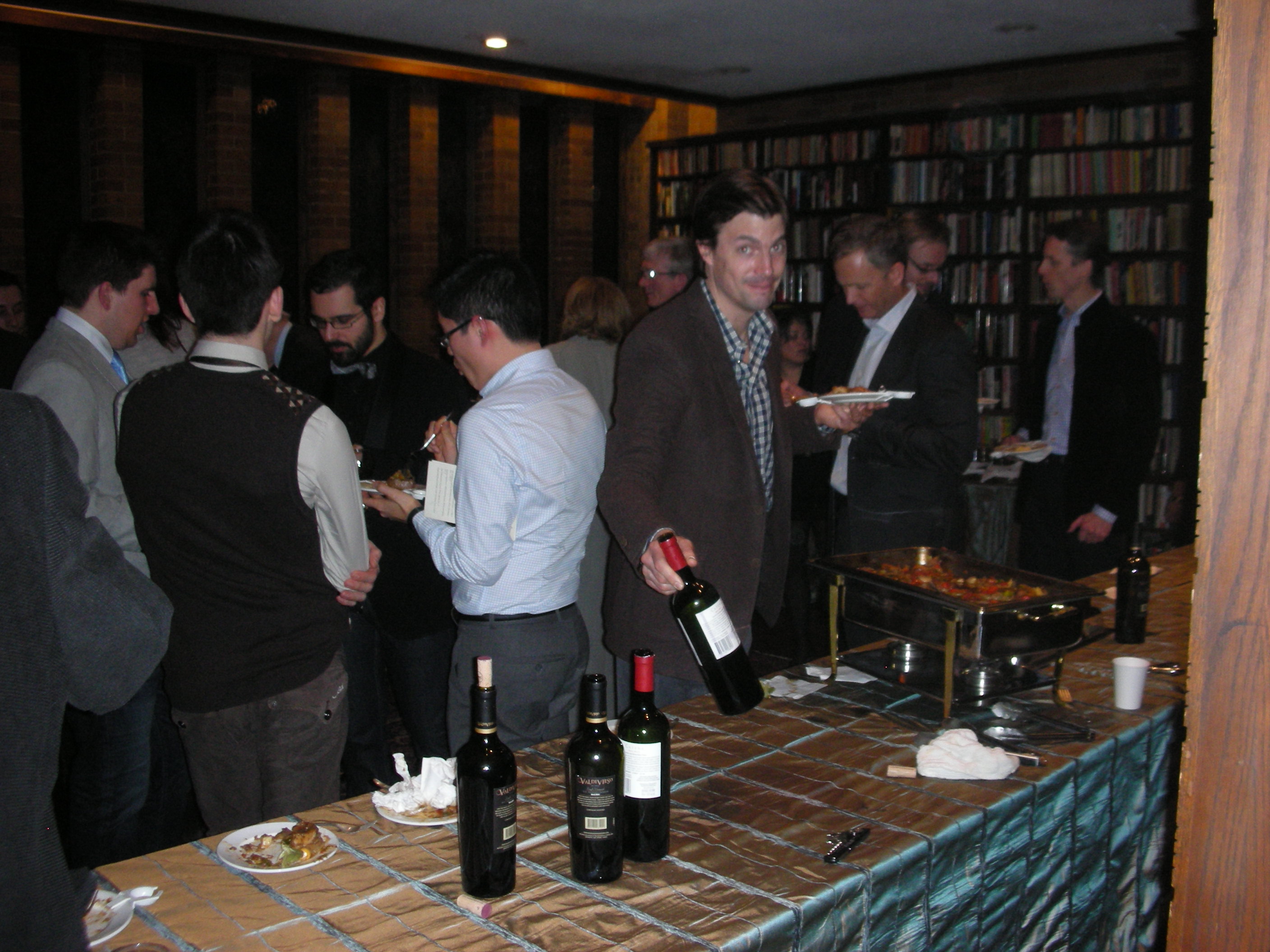
How might Dickens have described it: the snowflakes floating silently out of the darkness, drifting down into lanes and quadrangles, bearding the stone gables and clinging like a bride’s veil to the russet brick of Massey College. Inside, all is warmth and conviviality as the gowned and rosy-cheeked Master makes merry with graduate fellows and guests. Fine vintages flow; the high table groans under roasted fowl, rich sauces and forcemeats, spiced casseroles and curries, creams and sugared cakes. But step back into the night. There, amid the freezing slush of St. George Street, huddling for sustenance at the vendors’ carts, stand shivering students clutching their last few groats. Cold in their garrets, undergraduates at less civil colleges than Massey think of the stodge and slopkettle that waits for them in the residence dining hall and decide, once again, to make do with a slice of cheap, chewy pizza and a Coke.
That’s how I have always imagined the winter scene on the sprawling campus of the University of Toronto. And that’s why I am so grateful that it is Massey College, and not one of the other halls of learning, where I help out the resident wine club with it’s annual Grazing. We don’t sit at the high table and the Master is absent – but the food is always wonderful. Darlene Naranjo is in charge of all matters culinary at Massey and she nourishes the academic community there with great skill and imagination. Greg Cerson is the steward and facilitator of logistics. Thanks to him our group can process from the Common Room to the Upper Library and back again three or four times in an evening and each time find some new treat piping hot and ready to be tasted with wines already poured.
This year our theme was the wines of Argentina and Chile, the amazing speed with which their wine industries have come up to speed once the political horrors and corruption of the 1970s and 1980s were ended, and the recently evolving determination (mirroring Australia and Canada) to create fabulous high-end wines that reflect specific terroirs. Our little tasting was not a competition between the two countries, though their histories have been remarkably similar: conquistadors and mission priests planting the first vines (Criolla in Argentina, in the late 1400s; Pais in Chile, circa 1541), French vines and know-how arriving in the mid-19th century, foreign investment kicking in (finally) in the late 1980s and ’90s with modern equipment, modern thinking and the idea of export all catching on thereafter. Argentina has its special red grape in Malbec, Chile with Carmenere, both of them originally from Bordeaux, though Malbec was a major player until Merlot usurped its role and Carmenere was never more than an extra with a line or two of dialogue in a good year.
Here are some highlights from last night. Our first station featured a refereshing méthode Champenoise bubbly from Chile – Valdiviseo Blanc de Blanc Brut – necessary refreshment after the crowd had been listening to me talk for 20 minutes. We moved on to Tilia Torrontés 2009, a fresh aromatic white made from Torrontés, a natural cross of Muscat of Alexandria and Criolla Chica, the old mission grape, and the only variety we tasted that was actually born in South America. It smelt like Viognier with aromas of apricot, yellow plum and white flowers but was as crisp and fresh as a Pinot Grigio. We paired these wines with a traditional Argentinean empanada, like a tiny vegetable pasty with a hint of chili and yucca, made to a recipe from the area where the Torrontés was grown. People in Mendoza love their empanadas. They are sold on the street and everyone has their favourite concession stands. I remember visiting Mendoza in 1990 and the woman who was my guide to one of the wineries suddenly swerving her Mercedes into the side of the road when she saw an empanada stand. She was a very glamorous lady in her forties, an Hermès scarf knotted loosely around her throat, lots of jewellery, perfectly crimson nails and an incredibly haughty attitude. She wolfed down that empanada though, sighing and moaning with pleasure then licking her fingertips before we drove on – without a word being said.
The next Massey station set a very high standard. We poured the Luca Chardonnay that I have described before – a most delectable wine like a Meursault that’s come back from a holiday in the tropics with a Carmen Miranda hat. Beside that, we offered Underraga’s Terroir Hunter Sauvignon Blanc from the small Leyda Valley in Chile. While the recent pioneers in Argentina have gone vertically up into the Andes, planting vineyards at dizzying altitudes, in Chile the exploration has been outwards into the many valleys that twist down from the mountains to the Pacifc, north and south of Santiago. Some are hot, some cool, depending on the Andean and ocean breezes. The Leyda Valley was only planted in 2000 and it attracted attention because it seemed so like Marlborough in New Zealand – very dry, quite cool – less rain than New Zealand but similar temperatures, and perfect for Sauvignon Blanc. This wine is heady with grapefruit, lime, passionfruit, green grass, and a dry minerality at the finish as if you were sucking a pebble.
With this, the kitchen served a fillet of a buttery-rich, dense-fleshed white fish called corvina graced with plenty of citrus zest and fruit to balance the acidity in the wines. It was awesome with the Sauvignon Blanc.
Our third station presented two Malbecs – Catena Malbec from Argentina (seamlessly elegant) and Valdiviseo Single Vineyard Malbec from Chile (grown in a much warmer location, a tad rugged on its own but great with the food). The dish was osso buco with a brunoise of carrot, parsnip and leek and fire-roasted sweet red peppers.
At station four we poured two Argentinean reds – Trivento Golden reserve Syrah and Salentein Reserve Cabernet Sauvignon – both of which slipped down very easily with lean, pink loin of lamb crusted with pecan and thyme, a single Chinese gooseberry on the side.
Station five was reserved for a typical Chilean Carmenere from Marques de Casa Concha. We paired that with shavings of Idiazabal, the hard-to-find aged sheep’s milk cheese from Spain’s basque country that is smoked over beech wood. Carmenere’s story always amazes me – the grape brought over with all the other Bordeaux varieties in the 1850s but its identity lost along the way. It looks like Merlot but ripens much later, not until its own leaves have turned scarlet, so growers just called it “the late-ripening Merlot.” It was only in 1994 that a very astute French ampelographer identified it as Carmenère. Since Carmenère was virtually extinct in France I suppose we can include the grape on the short list of Lazarus toxons – species once thought extinct but rediscovered – of which the coelacanth is the poster child.
We finished with another Carmenere (Chileans have dropped the accent on the second e and pronounce all four syllables of the name), the spectacular Purple Angel 2007 from Vina Montes. Last year, Massey wine committee member Sabrina Abandali and I tasted dozens of Carmeneres at the Chilean wine show at the ROM, looking for our grand finale. This was the one we loved most. The company was created by a well-known winemaker and a group of eager investors in 1988 with the single purpose of producing ultra high-end wines – no cheap-and-cheerful money-makers – and that marked another step forward for the Chilean wine industry. The grapes come from the Colchagua valley – source of most of the great Carmeneres I’ve ever tasted – and the yield is kept extremely low so the wine is particularly intense. Drinking it is like painting a stripe of dark purple paint across your tongue – spicy, tannic, peppery paint with the flavour of blackberries, black currants, a little eucalyptus and just a hint of the metallic taste of your own blood. We served it with hot roasted chestnuts. And that was probably where the Dickensian mood came from, thinking of those old-fashioned treats as I trudged home from the College through the softly falling snow, my teeth stained a pretty purple from the angelic Carmenere.