

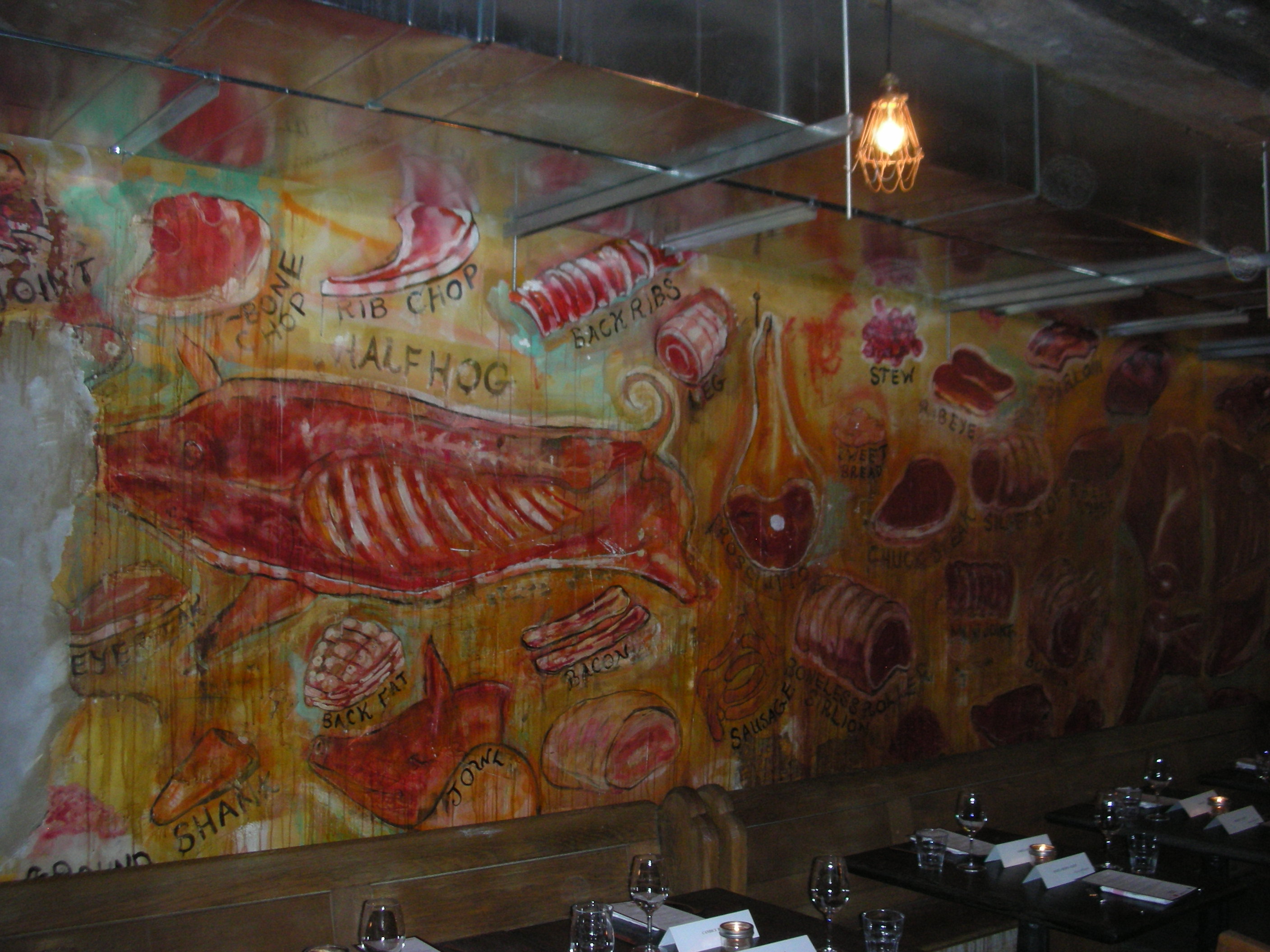
We had a fascinating preview of Rob Rossi’s new restaurant, Bestellen, last night when he and co-owner Ryan Sarfeld hosted a VISA Infinite dinner on the premises. It should open in early February but there have been some delays getting licenses from the City (Unheard-of! How astonishing!). Based on last night’s experience, I think Rossi is on to a sure thing for his first shot at chef-patron. The room is very long and narrow with a bar halfway down it and a big open kitchen at the rear. The décor is rustic but not rude with fine old barn boards on the ceiling and an arresting mural of animal parts on one of the walls. Meat will feature strongly on Bestellen’s menu (there’s a great big meat locker with a window for watching the beef dry ageing) and it was front and centre last night.
Robert Rossi, in case you didn’t know, was one of the three finalists in last year’s Top Chef Canada television show. He looks too young but has actually been in the business for a decade, first at Café Brussel on the Danforth, then Canoe for a couple of years, then Habitat, when Scott Woods was chef there and amazing the city with his molecular cooking. In 2009, Rob went west to be sous chef at The Chef’s Table in Calgary, then came back to Toronto to take over as Executive Chef of the four Mercatto restaurants. I thought he did a great job there – the food was always fresh, original, delicious and far more accomplished than it needed to be.
I had sort of assumed Bestellen might propose yet another domestic Italian menu, but no – it’s actually far more original. Last night Rossi showed he has an eye for the simple, rich, delicious dishes of pre-nouvelle French cooking. He also flaunted the charcuterie he has been working on since last summer, ably assisted by Grant Van Gameren, lately of Black Hoof. It’s all pork, dry-aged in house and I was struck by how moist and fresh it all tasted. We had a noce – a fairly coarse, fermented salami studded with crumbled walnuts that turn rather meaty when trapped inside a sausage for months (as who would not?). A fermented salami tastes tangier and more salami-like than your average charc. There was lonza (pork loin cured like prosciutto), a yummy chorizo, ruby-coloured copa and several others served with slices of fried house bread – basically a batard loaf made on the premises. As condiments he offered pickled ramps. Rossi goes fly fishing on the Grand River and when he has caught his limit he spends the rest of the day picking wild ramps from a large and double-secret patch.
There were other canapés – little one-bite brochettes of duck hearts speared with caramelized cippolini onion and smoked bacon cured with maple syrup and bourbon. The kitchen got the hearts just right – medium-rare rather than overcooked and grainy or undercooked and sticky. A simple tartare of albacore tuna, preserved lemon, green apple and basil served in a spoon was the best mjatch for our aperitif of very brut Champagne.
The first course dropped us into the deep end in terms of saturated fat. No fresh little salad to get us going. No. We had a cube of Ontario pork belly cooked sous-vide in duck fat and then deep-fried. The outside was delightfully crisp, the inside quiveringly unctuous. So delicious! Paired with some Brussels sprout petals, a little savoury chestnut purée and a sherry-caramel gastrique. A rich beginning, to be sure. The wine chosen for it, captivatingly introduced by my co MC, Jamie Drummond, was Pyramid Valley Vineyards Riverbrook Riesling 2008 from New Zealand, rich but clean, aglow with lime, petrol and honey aromas. Gorgeous on its own, it was a little put out by the gastrique, showing a sudden moment of bitterness. Not what one expects from a well-brought-up kiwivino.

The second course was an example of Rossi’s interest in retro sophistication – butter-poached lobster, courteously lifted out of its shell for us, the flesh impeccably tender. Beside it was a little lobster beignet that used up the knuckle meat from the creatures, stirred into a batter and quickly fried. There was salsify – as batons and as a purée. I love salsify – the pale but interesting, juicy but subtle love-child of an artichoke and an asparagus. But it’s not a vegetable you see much any more. The sauce was a classic Americaine made with the crushed lobster shells, vegetable mirepoix, tomato purée, wine and brandy, cayenne… One mopped it all up with the beignet. (I used to think Lobster à l’Americaine might conceivably be an American dish. Smack! comes the hand of Prosper Montagné and the Larousse Gastronomique. It was invented in Paris by Chef Pierre Fraisse of Peter’s Restaurant during the period of the Second Empire. He had to improvise a version of Lobster Provencale for some customers who were in a hurry and came up with what he called Homard a l’Americaine. Were the customers American tourists? Possibly. Fraisse himself had worked in Chicago for a while and according to Larousse, the chef was “still under the influence of his American sojourn.”) Either way, it was a smashing dish and the lobster itself was perfectly paired with Littoral Wines Charles Heintz Sonoma Chardonnay 2009. The wine and the sauce, however, wasn’t such a happy union.

On to the main event – roasted rib of 40-day dry-aged Wellington County beef, cooked on the bone sous-vide then finished in the oven. It came to the table on a platter for two to share, garnished with split marrowbones. Side dishes were button mushrooms with lemon beurre maître d’ and pommes aligot. Have you forgotten Pommes Aligot? It’s a dish from the Massif Central and the Pyrenees, basically mashed potato mixed with far too much butter and a little garlic, into which grated Appenzeller cheese is folded until it develops an almost elastic consistency, like a semi-solid fondue. The food of champions. It was an amazingly successful course and the wine match was absolutely first class – a big Californian Cab that had much more Bordeaux-style elegance than usual: Stonestreet Wines Monument Ridge Cabernet Sauvignon, Sonoma Valley 2007.
Following on, for those who might still be hungry, we moved to a trio of Canadian cheeses introduced by Angela Marsillio from the Dairy Farmers of Canada. Then dessert – a chomeur pudding. In French Canada, a chomeur is a poor man, a person on welfare, and this classic dish is a baked maple pudding, devised at a time when maple syrup was cheaper than sugar. Rossi’s version starts by coating the inside of a small Mason jar with cream and reduced maple syrup then filling the jar with layers of raw cakey-pancake batter and maple syrup. Bake it and serve it in the jar with a teaspoon and some crème fraîche – just an edge of lactic acidity to pretend to cut the sweetness… heaven in a jam jar, if entirely unrelated to the chosen wine, a stunning, heavy-duty Gewurztraminer from Alsace, Domaine Ostertag Selection des Grains Nobles 2007.
I liked what I saw of Bestellen and I foresee a bright future for the place. It’s located at 972 College Street (close to Rusholme). Phone 647 341 6769. Check out the site at www.bestellen.ca.